
DATPOL / BACKUP · EMS · AUTOMATION
Industrial backup power. Readiness demonstrated through testing.
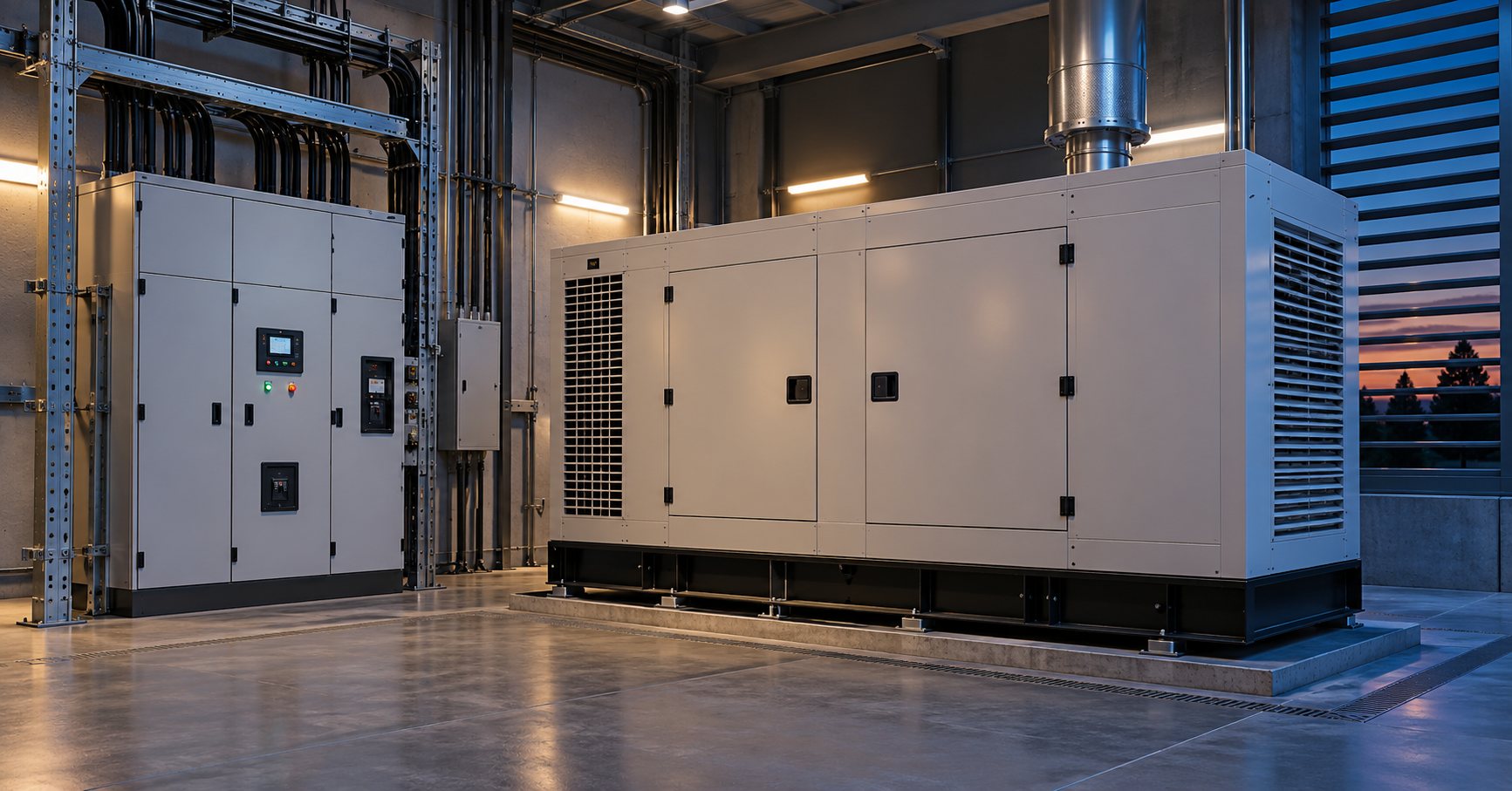
We design, deliver and maintain power systems that help limit the consequences of a grid outage. Generators, UPS, automatic transfer switching and battery storage are coordinated with automation, EMS and metering. From load assessment to testing the complete operating sequence and ongoing support.
Design and selection
Load assessment, measurements, options and acceptance criteria.
Installation and integration
Sources, ATS, automation, EMS and metering within a coordinated scope.
Testing and maintenance
Sequence testing, documentation, training and servicing.
Offer scope — jump to a section
- Start with the process, then select the sources
- Design and upgrades with defined interfaces
- Fixed and mobile generating sets
- AC UPS and DC control-system backup
- ATS, switchboards and return to the grid
- Battery storage and hybrid systems
- EMS: energy optimisation with a protected reserve
- Opomiarowani: understand demand and reserve use
- Automation, SCADA and DATPOL Control
- Safety-service supplies and site protection
- Acceptance: test the complete outage sequence
- Maintenance, inspections and service readiness
- Generator hire with delivery and support
- Manufacturing, cold storage, water utilities and logistics
- Standards
- Legislation and documentation
- Questions and answers
01 / DATPOL
Start with the process, then select the sources
Backup power is selected against the consequences of an outage: lost product, stopped production, cold-storage losses or unavailable communications. We establish what must remain uninterrupted, what can wait for generator start-up and what should shut down safely.
- Survey of loads and dependencies: production, cooling, compressed air, pumps, PLCs, IT and communications.
- Agreed maximum interruption time, required autonomy and load priorities.
- Load-profile measurements and assessment of starts, overloads, harmonics and future expansion.
- Comparison of capital and operating costs: fuel, batteries, servicing, energy losses and downtime.
02 / DATPOL
Design and upgrades with defined interfaces
You receive a coordinated concept for sources, distribution and control matched to the existing installation. Upgrades are phased around agreed outage windows to limit disruption to the plant.
- Single-line diagrams, load schedules, backed-up circuits, cable routes and connection points.
- Assessment of shock and short-circuit protection, selectivity and earthing in every supply mode.
- Single-point-of-failure review; N+1 redundancy or separate power paths where justified by requirements and analysis.
- Defined responsibilities for design, source suppliers, switchboards, automation and site operations.
03 / DATPOL
Fixed and mobile generating sets
Selecting a generator requires more than adding up nameplate ratings. We assess the load characteristics, environment and the manufacturer’s declared operating rating.
- Active and apparent power, power factor, step loads and starting the largest motors.
- Compatibility with UPS and drives, staged load connection and return after grid stabilisation.
- Siting, maintenance access, ventilation, exhaust discharge, noise and fuel arrangements.
- Monitoring of starting, starter battery charging, fuel and faults; autonomy related to actual load.
04 / DATPOL
AC UPS and DC control-system backup
A UPS supports agreed loads during short disturbances and standby-source start-up. For PLCs, instrumentation and communications, we also assess DC circuit backup.
- Selection of topology, output performance, overload capability and autonomy for the loads.
- Autonomy accounting for temperature, battery ageing, load and design margin.
- Maintenance bypass and safe servicing arrangements; assessment of common bypass-path risks.
- Battery testing, alarms, controlled service shutdown and UPS–generator compatibility tests.
05 / DATPOL
ATS, switchboards and return to the grid
Source transfer must behave predictably during grid loss, failed starting and supply restoration. The sequence is agreed before programming and checked during acceptance testing.
- Supply-quality supervision, delays, start attempts and switching-device position feedback.
- Interlocks against unintended source coupling and back-feeding the grid or an isolated circuit.
- Neutral arrangement, protection and switching equipment selected for the network and source configuration.
- Parallel operation with the grid requires separate assessment and network-operator arrangements; adding an ATS does not authorise it.
06 / DATPOL
Battery storage and hybrid systems
Battery storage can combine commercial operation with backup, but requires a suitable island-mode architecture. Grid-connected PV or a battery does not automatically provide supply during an outage.
- Verification of backup/EPS functions, island-mode power, starting capability and actual transfer time.
- Dedicated loads, minimum state of charge reserved for outages and charge/discharge power limits.
- Coordination of batteries, PV and generators, including grid-independent starting and depleted-energy behaviour.
- Siting and safeguards matched to battery technology, manufacturer requirements, fire conditions and maintenance access.
07 / DATPOL
EMS: energy optimisation with a protected reserve
We integrate backup power with energy management. Continuity priorities are encoded in the control logic so tariff optimisation does not consume the reserve needed to support the process.
- Demand profiles, power thresholds, schedules, peak reduction and PV self-consumption coordination.
- Reserved outage energy, load priorities and automatic shedding of less critical loads.
- Separation of EMS functions from local protection and independent source-transfer control.
- Measured results against targets: energy, fuel, operating hours and reserve availability; data support for ISO 50001 energy management.
Functional integration overview, not an electrical wiring diagram. Protection and critical functions remain in the local system.
08 / DATPOL
Opomiarowani: understand demand and reserve use
Metering supports sizing, operation and investment decisions. Through Opomiarowani, we provide measurement points, data collection and reports agreed with the installation owner.
- Measurements at the incoming supply, generator, UPS, storage system and selected production lines.
- Energy and power, voltages, currents, power factor and quality parameters supported by the selected instruments.
- Event history and trends, time stamps, stale-data indication and before/after upgrade comparisons.
- Operational metering is distinguished from billing; metrological and settlement requirements are agreed separately.
09 / DATPOL
Automation, SCADA and DATPOL Control
Operators need to see the active source, readiness and alarm cause. We integrate available signals into local visualisation and, within the agreed scope, DATPOL Control.
- Signals include grid available, generator ready/running, device positions, UPS on battery, bypass, faults and low energy reserve.
- PLC/BMS/SCADA integration through documented manufacturer interfaces such as Modbus, OPC UA or APIs.
- Control with state feedback, permissions and operation logs; loss of communication must not appear as healthy operation.
- Critical logic stays local. Loss of Internet or a dashboard must not block designed transfer and protection functions.
10 / DATPOL
Safety-service supplies and site protection
Production continuity and safety-service supplies are separate design duties. Where the system serves fire-protection equipment or other safety loads, additional requirements and dependencies are established.
- Coordination with the fire strategy and required behaviour of the fire-service electrical isolation arrangement.
- Load and cable-route separation and operating conditions appropriate to the system; autonomy follows the design and applicable rules.
- Ventilation, heat and exhaust discharge, fuel, batteries and fire risks assessed for the actual location.
- OT network segmentation, restricted access, individual accounts, configuration backups and controlled maintenance access.
11 / DATPOL
Acceptance: test the complete outage sequence
An unloaded generator start does not demonstrate that the plant can be supported. FAT/SAT scope, loads, acceptance criteria and a safe test plan are agreed before commissioning.
- Controlled tests for grid loss and restoration, failed starting, overload, alarms and communication loss.
- Testing with agreed actual loads or a load bank, recording voltage, frequency and system response.
- Verification of load-connection sequences, transfer times and autonomy using a method suitable for the system.
- Measurement and test records, defect lists, settings, configuration backups and operator training.
12 / DATPOL
Maintenance, inspections and service readiness
Reserve readiness depends on regular attention, not equipment purchase alone. The maintenance schedule follows manufacturer documentation, operating conditions, running hours and process criticality.
- Checks of fuel, starting, chargers, batteries, connections and alarms; functional tests to an agreed schedule.
- UPS/BESS battery ageing assessment and planned replacement of batteries, consumables and documentation updates.
- Service reports, prioritised recommendations and periodic review of changes to plant demand.
- DATPOL CARE scope, support hours, response times and parts availability are contractual; 24/7 support is not assumed.
13 / DATPOL
Generator hire with delivery and support
We offer temporary power for planned outages, upgrades, construction and events. Location, equipment, dates and logistics are confirmed for each booking.
- Power and accessory selection, delivery, agreed unloading, siting and collection after hire.
- Connection, protection and distribution arrangements; commissioning within the booked scope.
- Agreed refuelling, supervision and servicing during hire.
- Travel to the customer’s site; price, availability and response time confirmed before booking.
14 / DATPOL
Manufacturing, cold storage, water utilities and logistics
The backup scope is matched to the site. Supporting critical loads and safely stopping the remainder may be more appropriate than supplying the whole plant.
- Manufacturing: controls, lubrication, cooling and line restart procedures.
- Cold storage and food processing: storage conditions, staged compressor starts and parameter records.
- Water utilities and pumping stations: pumps, levels, telemetry and staged starts.
- Warehouses and IT: automation, communications, server rooms, security and agreed technical equipment.
SOURCES REVIEWED: 8 OCTOBER 2026
Standards have defined scopes. We match them to the solution.
Polish Standards are generally voluntary. Legal, design and contractual requirements and the means of demonstrating conformity are established separately. The selection below identifies design areas; it does not replace the full licensed standards. PKN ↗
PN-HD 60364 ↗
Low-voltage installation: protection, wiring selection, earthing, sources and verification. Applicable parts are selected for the configuration, including generating sets and installation verification.
PN-HD 60364-5-56:2019-01 ↗
Safety services. This is not a general production-backup standard: standby electrical supply systems are outside its scope.
PN-EN ISO 8528-13:2026-09 ↗
Generating-set safety; the edition published on 16 September 2026 replaced Part 13 from 2016. Other applicable parts of the 8528 series address operating characteristics and testing.
PN-EN IEC 60947-6-1:2023-10 ↗
Transfer switching equipment. We check the standard’s scope and complete-system documentation; not every multi-source configuration falls within this part.
PN-EN IEC 62040-3:2022-01 ↗
AC UPS performance and testing. Safety and electromagnetic compatibility are assessed under the applicable 62040 parts; DC UPS has a separate scope.
PN-EN IEC 61439 ↗
Low-voltage assemblies: Part 1 together with the relevant product part, documentation and assembly verification. Component conformity alone does not establish conformity of the whole switchboard.
ISO 50001 ↗
Organisational energy management. EMS and metering data support energy-performance evaluation; buying an EMS does not constitute ISO 50001 certification.
Before design, we check edition status, amendments, corrections and references in project documents. Batteries, machinery, explosive atmospheres and safety services require additional product- and installation-specific requirements. A new edition does not in itself require replacement of every existing device.
Legislation, responsibilities and handover records
For projects in Poland, we establish the work classification, construction procedures, fire and environmental conditions and network-operator arrangements. Applicable legislation and transitional provisions are confirmed for the design date and building use.
- Polish Construction Law: design duties, building maintenance and inspections. The five-year electrical-installation inspection does not replace more frequent servicing required by equipment documentation and operating conditions. Legislation ↗ · GUNB ↗
- Documentation includes the agreed design, as-built drawings, settings, equipment declarations and instructions, measurement records, test results and maintenance plan.
- Commissioning and operational work require qualifications appropriate to the scope; safe-working and fault-response procedures are agreed.
- The applicable standards and acceptance criteria are recorded in the documentation. A declaration for one device does not verify the complete integrated installation.
This offer describes projects and regulatory requirements in Poland. The English-language version is not a claim of compliance with UK regulations.
Questions before investing
Does a generator replace a UPS?
Not for loads that must remain powered during generator start-up. The permissible interruption and architecture are established for the process.
Will a PV battery power the plant during an outage?
Only if the equipment, isolation arrangement and controls are designed for it. We check island capability, power, load starting and available energy.
Can existing generators and meters be retained?
Yes, subject to condition, documentation, integration and capacity checks. The quotation can cover only ATS upgrades, metering, EMS or monitoring.
Does control require Internet access?
Local transfer and protection functions are designed independently of Internet access. Remote access supports monitoring and only agreed, authorised operations.
What determines the price?
Load rating and characteristics, autonomy, connection infrastructure, continuity needs, automation and test scope. Design, equipment, installation, integration and maintenance are priced separately.
DESIGN · DELIVERY · MAINTENANCE
Tell us what must keep running when the grid fails.
Send the location, load list, existing documents and required autonomy. We will agree a survey, measurement scope and solution options. The quotation separates design, sources, installation, automation, EMS, metering, testing and optional support. For hire, include the dates and delivery conditions.